
You know you are bang in the middle of Prakash Jha territory when politics, democracy, policing, encroachment of forest land, reservation, the caste system are repeatedly invoked in a story crammed with dizzying twists and turns. In Aashram, an MX original series (both the seasons)that packs quite a punch, the veteran producer-director adds religion to his collection of socially grounded themes.
He has used this series to reflect upon the infiltration of blind faith into India’s public life and its deleterious consequences. The nine-episode series rests on the theme of a manufactured personality cult. It explores the nuts and bolts of andh-bhakti or blind faith from which a godman’s power flows and gnaws away at the vitals of the heart of a society with multiple faultlines.
The series shows us the dark side of our society where crime, cover-ups and crass compromises by people in power puts the weak and the gullible at the greatest risk. In this context one dialogue that really stands out is “Bhakti ki zaroorat, kamzor aur gareeb logon ko zyaada hoti hain na.”
The production designing is splendid which completely sets the tone. The socio-cultural landscape portrayed in Aashram is, unsurprisingly, loaded against women. The episodes might feel a bit lengthy at times but at times I felt it was necessary for the establishment of the plot and characters.
Aashram, introduces Baba Nirala (Bobby Deol) like a superstar in a masala film. Baba Nirala played by Bobby Deol is effective but lacks that genuinety of a godman. He seems quite restricted and hence the depth is missing but compared to his career graph he has done a decent job I would say. But even if he’s the projected lead in the series he’s not so according to me there are other people who shine more than him like his trusted aide Bhupinder alias Bhopa played by Chandan Roy Sanyal who nails it and is absolutely amazing as the badass right hand of the godman. Dalit girl Pammi Lochan played by Aaditi Phankar is the star of the series according to me who being a Maharashtrian girl has carried the role of a haryanvi wrestler with absolute ease and effortlessly being. Her brother, Satti played by Tushar Pandey is also great as the naive and gullible person who is a perfect fit for the role of an Andh bhakt. Sub-inspector Ujagar Singh played by Darshan Kumaar has been portrayed by great strength. His chemistry with Dalit constable Sadhu played by Vikram Kochchar is quite heart rending. Local cable news journalist Akki Rathi played by Rajeev Siddhartha is quite a significant character played with lot of genuineness.
Natasha Katiyar played by Anupriya Goenka & Babita played by Tridha Choudhury are the two most strongest female characters in the series after Pammi.
But the series is quite a binge worthy project even with a bit of faultiness in bits and pieces here and there. The cliff hangers really keeps you waiting for season 3 desperately!!
Assignment 11 : Radio as a Mass Media
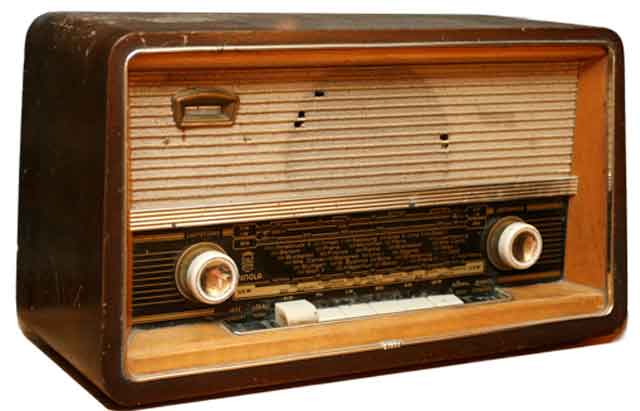
Radio was the first truly mass medium of communication, reaching millions of people instantly and altering social attitudes, family relationships, and how people related to their environment. Radio is an attractive medium among the various mass communication media because of its special characteristics.
Radio is widely used mass communication medium and has a great potentiality in dissemination of information as radio signals cover almost entire population. More than 177 radio stations are there across the country. About 97 percent of the population is reached by the radio.
Radio being a convenient form of entertainment caters to a large audience. With the advent of transistors this medium hrs reached the common man in urban and rural areas of India, though the utilization of radio is more among rural elites.
It has advantages over the other mass media like television and newspapers in terms of being handy, portable, easily accessible and cheap. It is the most portable of the broadcast media, being accessible at home, in the office, in the car, on the street or beach, virtually everywhere at any time.
Radio is effective not only in informing the people but also in creating awareness regarding many social issues and need for social reformation, developing interest and initiating action.
For example, in creating awareness regarding new policies, developmental projects and programs, new ideas etc. It can help in creating a positive climate for growth and development.
It widens the horizons of the people and enlightens them, thereby gradually changing their outlook towards life. Research has shown that radio is an effective medium for education when it is followed up with group discussion and question- answer session.
In India, radio with its penetration to the rural areas is becoming a powerful medium for advertisers. It gets 3 percent of the national advertising budget. Radio is still the cheap alternative to television, but is no longer the poor medium in advertising terms.
Because radio listening is so widespread, it has prospered as an advertising medium for reaching local audiences. Moreover, radio serves small highly targeted audiences, which makes it an excellent advertising medium for many kinds of specialized products and services.
As far as commercials are concerned, no one is able to tune out commercials easily as is possible with remote control devices and VCRs. It is thought that radio’s ability to attract local advertisers hurts mainly newspapers, since television is less attractive to the small, local advertiser.
As far as audience is concerned radio does not hamper persons mobility. As a vehicle of information for masses it is still the fastest. For instance, it would take less time for a news reporter for radio to arrive on the spot with a microphone and recorder than the same for TV along with a shooting team and equipment.
Another important feature of radio as mass medium is that it caters to a large rural population which has no access to TV and where there is no power supply. In such places, All India Radio’s programmes continue to be the only source of information and entertainment. Moreover, AIR broadcasts programmes in 24 languages and 140 dialects.
“Radio should be treated akin to newspapers in view of the fact that it is local, inexpensive, linked to communities, has limited band width and operates through simple technology”.
The economics of radio does allow tailoring programme content to the needs of small and diverse audiences. Thus it is economically viable to recast a programme for broadcast to audiences in different sub regional, cultural and linguistic context.
This enhances the value of radio as a medium in networking developmental programmes. Thus, it offers many possibilities in networking, from locally or regionally co-ordinated broadcasts and interactive exchange of queries and data.
It can serve as a standalone medium of information dissemination or a support medium for curricular learning, jointly with print material or with fieldwork.
Kapoor, Director general of AIR (1995) said, ” Radio is far more interactive and stimulating medium than TV where the viewer is spoon-fed. Radio allows you to think, to use your imagination. That is why nobodyever called it the idiot box”.

Assignment 10 : Reporting on Science Fiction and Reality
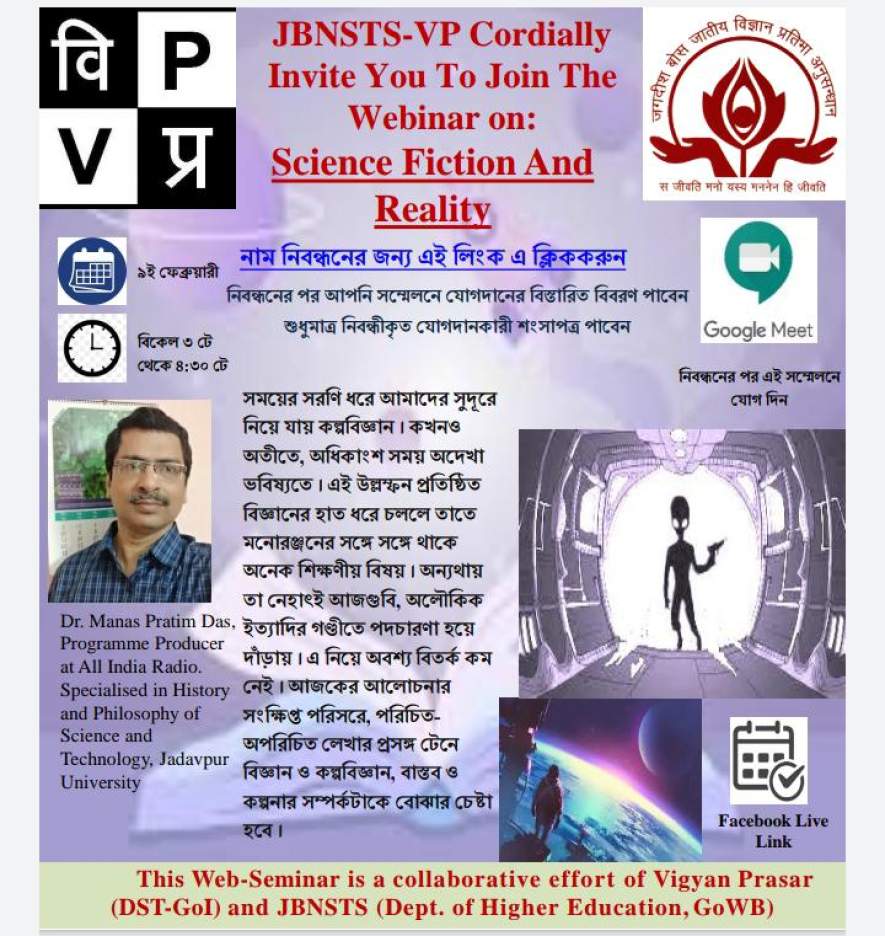

Kolkata, February 9: “Science fiction has taken us far and wide over time. Never in the past, most of the time in the unseen future. If this leap continues in the hands of established science, there are many lessons to be learned along with entertainment. Otherwise, it becomes a step in the direction of strange, miraculous, etc. Of course, there is no less debate about this. ”
Science fiction is a subject that has no end. The only goal of those who have researched and pursued science is to bring science to the common people, to the students. To develop a science-minded attitude. In the current New Normal situation, people have become accustomed to virtual platforms. Jagadish Bose National Science Talent Search and Science Promotion has taken such an initiative. A webinar was organized on Tuesday, February 9, 2021 in their joint venture. The theme of the webinar was “Science and Fiction, Real”. The webinar starts at 3 p.m. The main speaker of the discussion was the program producer of Akashvani. The mind is the perfect slave.
Today’s discussion was moderated by Mr. Abhijit Kar. Mrs. Maitri Bhattacharya gave the inaugural address at the beginning. He also introduced today’s keynote speaker Manasbabu to everyone. Speaker Manasbabu shed light on today’s topic through a beautiful presentation. He first spoke of Arthur C. Clark. Who has been called the father of satellite communications. He worked with the radar. Went to Sri Lanka for scrubbing. On May 25, 1945, his novel The Space Station was published, where he gave an idea of the satellite. The first communication signal went in 1980, dubbed ‘Courier 1B’. The signal was first sent from the United States. He wrote a letter, through which he introduced science fiction. This signal showed slowly realizing Clark’s imagination. In 1969 he wrote a novel called Clarke Clipper. There he mentioned the elevator that would go up to the satellite. Manas Babu is also talking about Russian scientist Konstantin Slovsky and Fred Hail.
Assignment 9 : Types of Radio Programmes
Variety is the spice of life – or so they say. The same is often true for radio programmes.
Chart Shows
Chart shows are a classic program type that you can add to your line up. Music chart shows are a countdown of the top-rated songs for the week or the month. You could create a chart of your own based on audience opinion and listener stats, or opt to broadcast a more well-known chart, such as a Billboard chart.
Entertainment Programs
Entertainment segments can provide some light fun to your radio programming. These shows can include stand-up comedy clips, funny reviews, call-in quizzes, and fun competitions for your listeners. These segments could serve as an entertaining change of pace between music and talk segments.
Late Night
Late evenings usually have fewer listeners tuning in, which could be a great time to debut new DJs who are still finding their groove. Late-night programs are often music-centric, though it often depends on a station’s late-night listener stats.
Live Shows
Live radio programs are broadcast in real time. There are plenty of options when it comes to live shows – be it talk, an interview, or live-event coverage. Broadcasting live is a fantastic way to engage your listeners in real-time events, by taking live calls, and allowing shout-outs, and more.
Morning Wake-Up Shows
The Morning Show is another staple in the world of radio. This is your chance to help your listeners wake up and get pumped for the day ahead. For area-specific stations, morning programs are a great opportunity to cover recent events, news, traffic, and weather, to prepare your listeners for the day.
Music Shows / Genre Specific Programming
Music shows are just that – centered around music. The average online radio music program may consist of an hour or two of nothing but great tunes. Music shows can be specific to a genre (disco, country), a decade (70’s, 80’s), or even a theme (movie soundtracks, workout music, etc.).
News and Weather
News and Weather segments are a great way of sharing useful information with your listeners. You can cover current events, weather, and exciting news stories on a local or global scale.
News and Weather
News and Weather segments are a great way of sharing useful information with your listeners. You can cover current events, weather, and exciting news stories on a local or global scale.
Radio Dramas
While the term “Radio Drama” might seem a bit outdated, many of these appear as podcasts today. Radio Dramas refers to programming that consists of stories, comedies, musicals, and more, that rely on dialogue and sound effects to tell a story. Radio dramas, depending on your demographic, remain a great way of entertaining your listeners every once in a while.
Request Shows / Call-In Shows
Request shows are an excellent way of engaging your listeners and enabling them to feel like they are a part of the show. These are usually live online radio shows that allow listeners to share real-time opinions or make live, on-air requests and shout-outs.
Specialty Shows
Specialty shows are a fantastic way of breaking from regular programming or long blocks of music. These types of shows can cover fun and interesting topics such as travel, technology, history, or celebrity news. These segments can cover a fun new destination once a week (travel), the latest and greatest tech (technology), interesting figures from history, and more.
Sport Programs
Sports programs cover the latest in sports related to news, athletes, game coverage, and more. Online radio sports programs can also include live coverage of sporting events.
Talk Shows / Talk Radio
Talk radio typically consists of radio hosts discussing current affairs or events. These discussions may occasionally include special guest interviews and listener opinions. Talk shows could provide a relevant and informative break from music radio.

Assignment 8 : History of Radio after Independence& Radio Propagation for Wireless Communication.

Radio broadcasting began in India in 1922. The Government owned radio station All India Radio dominated broadcasting since 1936 but through privatization and deregulation has allowed commercial privately owned talk and music stations to reach large audiences
The company went into liquidation on 1 March 1930. The government took over the broadcasting facilities and began the Indian State Broadcasting Service (ISBS) on 1 April 1930 on an experimental basis for two years, and permanently in May 1932 it then went on to become All India Radio on 8 June 1936. When India attained independence, there were six radio stations within Indian territory, at Delhi, Bombay, Calcutta, Madras, Tiruchirapalli and Lucknow.FM broadcasting began on 23 July 1977 in Chennai, then Madras .
Assignment 7 : Radio Talk on Budget 2021
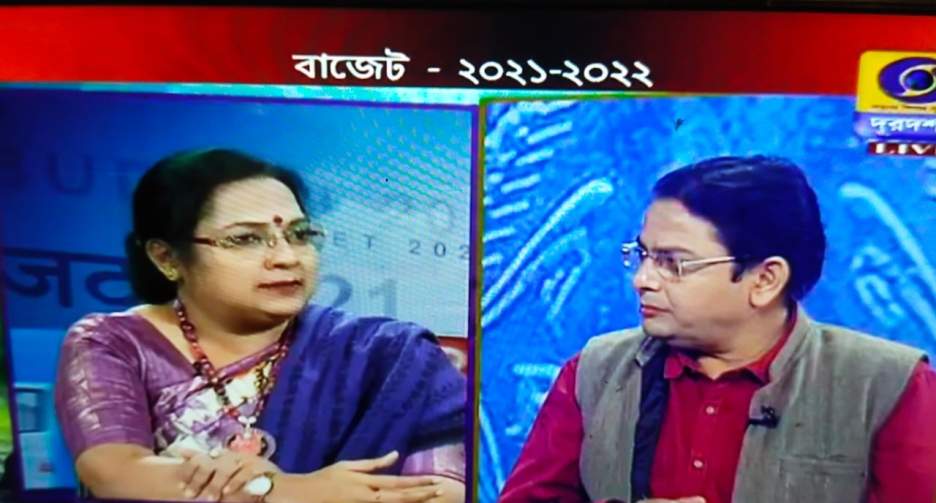
The economic situation around the world is much worse because of the Covid epidemic. Speaking of a self-reliant India in this situation, Hon’ble Finance Minister Nirmala Sitharaman presented the budget on February 1, challenging the country’s economy. On that day, the principal of Vijaygarh Jyotish Roy College Dr. Rajyasri Neogy was present on the program ‘Budget 2021-22’ of Doordarshan channel. Rajyasri Neogy, was Chartered Accountant Shri Surjit Roy, former Professor Jadavpur University Economist Gautam Gupta and Economics Specialist Dr. Aditya Das. The economists present spoke on the budget presented by the finance minister under the pressure of expectations. The first speaker, Aditya Das, said that such a situation had never been seen before in independent India. In this situation, the finance minister had to come up with a budget. Dr. According to Rajyashree Niyogi, efforts are being made to bring back the rate at which the common man has been harmed, to get out of this dire situation. One of his directions may come out of this year’s newly introduced budget. He thinks that if more affordable income is provided for the people then it is very good for the common people. Then Dr. Gupta talks about ‘V Sep Recovery’. Surjit Babu personally said that the budget has been good. He said this budget should not be seen only in terms of 2021-22. The four experts present discussed the issue from all sides. Although there are some problems, there is hope. The future will tell whether the transition of the economy will take place or not, whether it is a sign of good health of the economy with huge collection of GST or not.
According to the new budget, Tk 25,000 crore has been allocated for Bengal, which will be spent on construction and renovation of 75 km of new roads. This includes road repairs from Kolkata to Siliguri. The Finance Minister said Kharagpur-Vijayora, Dunkuni-Gomo freight corridor will be constructed. Prime Minister Narendra Modi has explained the need for extra attention on the railways. In his post-budget speech, he said West Bengal was one of the states in the country that he wanted to build as a business powerhouse of the future. On the other hand, one crore rupees has been allocated for the tea industry, which will help the tea industry in West Bengal and Assam. However, after so much, there is a frustrated part as there is no allocation for the state’s metro project. With this new budget. Rajyashree Niyogi is very optimistic. He thinks a lot of people will benefit from it. Those who have lost their jobs, who have suffered a lot, will find employment again.
No changes have been made to the tax structure in this time’s budget. Has announced special discounts for senior citizens over the age of 65. If you buy a new flat, interest free up to Rs 1.5 lakh till March 31, 2022. In addition, many more concessions have been made in this budget.
Budget means trying to show a direction, budget means trying to build the word of the future. The country and the people of the country are the main target there. People will be looking at how the budget presented by the Hon’ble Finance Minister for 2021-22, based on the survey, will yield results in the future. If all the directions that have been shown in this budget, which have been expressed in the hope that in reality the country will benefit as a result, the people will benefit.
Assignment 6 : Write a short planing script of Radio Feature
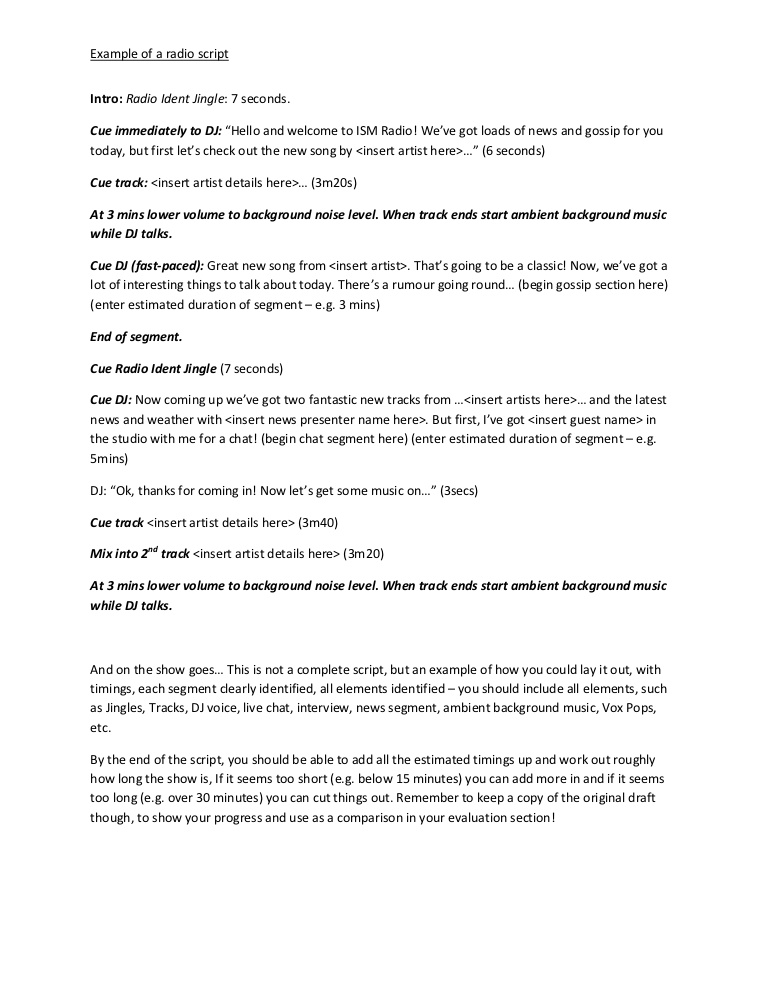
Assignment 5 : Short note on Radio Feature

Radio Feature is a spoken word radio format devoted to non-fiction narrative. It is broadcast on radio as well as distributed through media such as tape, CD, and podcast. A radio documentary, or feature, covers a topic in depth from one or more perspectives, often featuring interviews, commentary, and sound pictures. A radio feature may include original music compositions and creative sound design or can resemble traditional journalistic radio reporting, but covering an issue in greater depth.
Assignment 4 : Short note on Radio Jockey
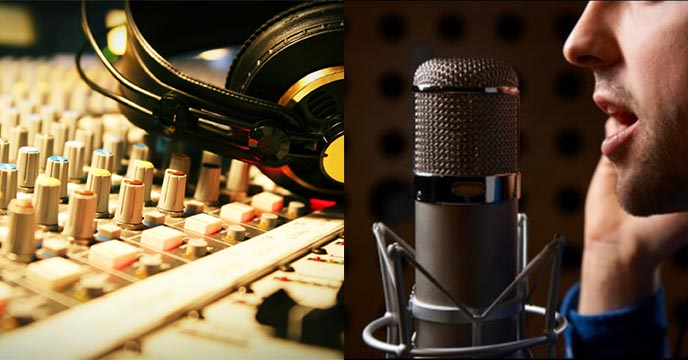
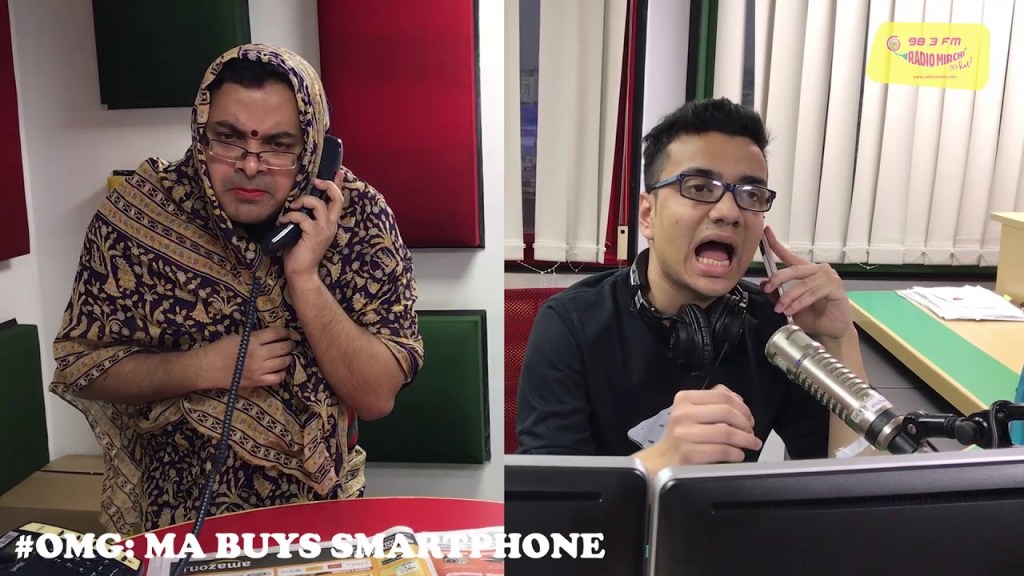
A Radio Jockey is a person who hosts a radio talk show where the RJ selects the music to be played, or topic of discussion, by interacting with the audience; the interaction is often via telephone, but may also be online, or via email. This term is primarily used by Indians who coined it from the Western Disc Jockey.
A Radio Jockey, popularly known as a RJ, is a person who hosts a talk show on the radio. In simple words, Radio Jockey is the ‘sutradhaar’ of an assigned show on radio.
Here’s what you need to become a Radio Jockey.
- The good news is you are not required to be highly educated to become a Radio Jockey or RJ but you do need some skills and basic education. So, if one wants to start a career as a Radio Jockey, he or she should first complete an undergraduate degree or bachelor’s degree in mass communication.
- Secondly, an internship can take an aspirant in the right direction as it offers practical exposure.
- Further, to make progress in this career one should make great professional contacts as referrals work wonders at times. Networking is the key.
- However, referrals work only when you are great at what you do. This being a highly creative field, some of the qualities required are imagination, wit, out of the box thinking and a voice that can move people. Not necessarily in that order though.
Assignment 3 : Community Radio
Need for Community Radio
There is a need for community radio for the following reasons :
Difference in culture and custom as common in a diversified country, such as India.
Democratization.
Decentralization.
Relaxation of broadcasting monopolies.
Access to proper information.
Awareness of social and economic benefits.
Equal rights for all communities.
Features
Audience as Protagonists – The audiences are protagonist cause the shows are for them,
by them and they come and talk about their issues and solutions are discussed.
Ownership – The complete ownership falls under the community and it’s members only.
Management – All the management responsibilities are controlled by the community
members only. Outsiders may participate but they have to talk about the community and
their issues only.
Funding – It’s done by the community members and sometimes sponsors or other people
also give donations.
Editorial Independence and Credibility – The community and it’s members have all the
editorial independence as they don’t work under any particular media house or editor. So
all the credibility is their own.
Inclusion of Minority and Marginalised Groups – There are community radio for the
minority and marginalised groups like women, Dalits, tribal people, etc. It includes their
issues and gives them a voice to raise their issues.
Representation of different groups and interests in community – Community Radio
involves and includes all kinds of different groups and their interests in community.
Functions
Reflect and Promote Local Identity and culture.
Create a diversity of voices and opinions.

Radio is chosen as a medium of communication for the following reasons :
Cost efficient
Blind medium
Portable
Secondary Medium
No electricity required
Can reach people across all social strata
There are four tires of Radio, as follows :
Public Service Broadcasting
Private Sector (F. M.)
Community Radio
Internet Radio
Community Radio
“Community radio responds to the needs of the community it serves, contributing to its
development within progressive perspectives in favour of social change. Community radio
strives to democratize communication through community participation in different forms in
accordance with each specific social context.” – World Association of Community Broadcasters
(AMARC), 1988.
Community radio is an alternative media which is non-commercial and advocates for those who
are excluded from mainstream.
Community Media is formed to give service to community, put tools in hands of community. It
aims to facilitate people centered development and creates awareness. It covers a range of 10 –
15 km max.
Community radio is non – profit making in nature and the ownership and control falls under the community itself. There is only community participation.
>Encourage Open Dialogue and Democratic Process.
Promote Development and Social Change.
Encourage sharing of Information and Innovation.
Gives Voice to the Voiceless.
Involvement of Women.
Evolution of Community Radio
Miner’s Radio in Bolivia Started in 1947
- United miners for better working conditions.
Radio Sutatenza in Colombia started in 1947 - Organized peasant community by educating them through radio.
South Asia - First community radio station established in Nepal in 1997 (Radio Sagarmatha).
- Bangladesh was the second country to adopt community radio station.
- In India, community radio broadcasting policy was passed in 2006.
Community Radio in India
Year
Snapshots
1995 Supreme Court declared airwaves are public property.
1999 Radio broadcasting shifted from government monopoly to commercialized broadcasting.
2000 UNESCO sponsored workshop in Hyderabad.
2004 MIB prepared draft policy on Community Radio.
2005 Draft policy was referred to group of ministers.
2006 Union Government passed the policy.
2008 MIB received 297 applications for community radio licenses.
2011 First Sammelan of Community Radio stations in Delhi.
Indian Scenario
289 community radio stations till 31.03.2020.
Anna Radio (Educational and Multimedia Research Centre)
Sangam Radio
Radio Namaskar
Alwar ki Awaz
Kumayun Vani
Dhan Foundation
Radio Henvalvani
West Bengal – In 2008 Jadavpur University started first community radio station.

 Rajrupa Das 3rd Sem (Blog Assignment)